Wednesday, June 19, 2013
Book Thoughts: Notes from My Travels by Angelina Jolie
I recently finished Angelina Jolie's journal from her travels to developing nations in 2001-2002. It was pretty much what you would expect. Basically you take a rich and famous movie star, plop her into a third world country, and tell her to write about what she sees. That's pretty much it. While it wasn't a total waste of time, there was nothing overwhelmingly spectacular about the book. It was not particularly well written, but I won't judge Jolie too harshly for that (after all she does warn us at the beginning that she is not a writer and was quite hesitant to publish her journals.) I was more astonished and appalled by Jolie's lack of research in preparation for her visits. For instance, when she arrived in Pakistan the UN contingent had to immediately find her some acceptable clothing. I mean really, Angelina, I'm sure UN workers have better things to be doing than taking you shopping for a burqa.
Another thing that bothers me about the book is that Jolie seems to grossly oversimplify the problems in the developing world. Basically, it comes down to the fact that we (the U.S? American citizens?) are not doing enough to help. We need to give more money. It keeps coming back to money. Money will fix all the world's problems. There is no appeal to the complicated and deep-seeded problems wrought by decades of colonialism (i.e. lack of industry, soaring population growth, environmental degradation, corrupt and incompetent leaders, tribal rivalries, etc). Jolie's lack of background knowledge about the places she's visiting leads her to the most simplistic answers. Quite frankly, she just sounds stupid.
Where, Angelina, should that money come from? Should we borrow money from China to donate to Africa? Or should it come from citizens? Perhaps if we all stopped going to movies we could make a significant dent in world hunger. And how exactly are you helping by traipsing around in a UN baseball cap? I'd venture to guess that the cost of your trips to "raise awareness" probably could have put a village full of kids into school for at least a year.
So, reader, if you want a truly worthwhile book on this topic let me suggest a few from people who have actually LEARNED about the developing world, SACRIFICED a good deal of money and comfort and ACCOMPLISHED something tangible.
Probably my top recommendation would be Mountains Beyond Mountains by Tracy Kidder. This book chronicles the story of Dr. Paul Farmer, a renown doctor who chose to invest his money and life into building up Partners in Health (PIH), an NGO bringing medical care to the world's poorest countries. I read this book several years ago and it stuck with me. Dr. Farmer is an incredible man.
Second, try Three Cups of Tea. This is the story of mountain-climber-turned-humanitarian, Greg Mortenson. After getting lost while attempting to climb K2 Mortenson ended up in a small Pakistani mountain village. This experience changed his life. He went on to establish the Central Asia Institute (CAI) whose mission is to build schools in the tribal areas of Pakistan and Afghanistan. Over the years Mortenson has risked his life to bring education to Afghani and Pakistani the boys and girls in some of Asia's most dangerous regions. Again, a truly remarkable and courageous figure.
Meanwhile Jolie is back in LA, having an expensive preventative surgery, followed by another expensive reconstructive surgery. All the while thousands of children are dying because they didn't have money for a simple vaccination. Nice work, Angelina. Enjoy those new boobs.
Friday, June 14, 2013
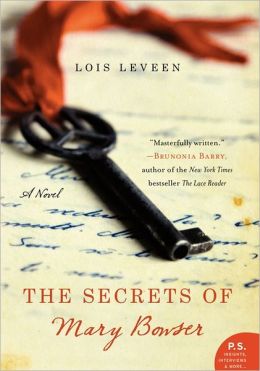
Book Thoughts: The Secrets of Mary Bowser by Lois Leveen
This summer I am enrolled in a course for American History teachers focusing on the use of primary documents in the classroom. As part of our course reading, we were required to read the historical fiction book entitled The Secrets of Mary Bowser. While this book is fiction, it is based on the life of an African-American woman who worked as a spy for the Union. It was a truly fascinated read and it taught me a lot about the Civil War and the years leading up to the conflict.
The book starts off with Mary as a child. She and her mother are owned my the Van Lews, a merchant family in Richmond that originally hailed from the North. Because Mary's mother, Minerva, used to be a slave in the North she was literate and passed this on to Mary. When the Van Lew's Northern-educated daughter, Bet, comes back from Philadelphia spouting grand ideas of abolitionism, she is pretty much ignored until the day she acquires the resources to buy her mother's slaves and offer them freedom. Unfortunately, freedom does not mean much for Mary's mother. Minerva is married to Lewis, a blacksmith enslaved to another Richmond gentlemen. Since freed slaves are not allowed to stay in the state of Virginia at the time, Minerva must make a choice about whether to stay with her husband or go North with her daughter. She chooses to stay. Bet pays for Mary to attend school in Philadelphia were she meets free blacks of all classes and becomes involved in the Female Anti-slavery Society there.
As Mary grows up she realizes that she wants to be more intricately involved in abolition, especially as the country moves closer to war. She also wants to be near her family. She moves South, marries, and work to support the North and the causes of freedom. Through a series of opportune circumstances Mary becomes a "slave" in Jefferson Davis's household. Really, Mary is a spy. She plays into the Davis's stereotypes of a dumb, illiterate slave, all the while ferreting messages out to help the North win the war.
Below I've included a few thoughts in response to some of the discussion questions we were asked to answer for class:
1.
Pick an
episode or a detail that you found surprising in the book. Why did this
particular facet strike you as unusual?
When Mary is freed by Bet Van Lew she is
sent to Philadelphia, the City of Brotherly Love to attend school. Philadelphia
was originally settled by Quakers and in the mid-1800s it remained a major
haven for that sect of Christianity. I had always believed that Quakers were
rare among Americans for their tolerance and charity toward others races.
However, I learned that not all Quakers subscribe to full equality for the African-Americans who attend their churches.
When Mary visits the Arch Street Meetinghouse she is directed to a bench in the
back reserved for the black attendees. Later, when Mary questions here Quaker
friend Zinnie about this practice, Zinnie emphatically declares that not all Quaker meetinghouses are so
segregationist. Zinnie is a Hicksite Quaker. Their principles are more
consistent with the tolerance and charity that I have always believed
characterized the Quakers. What I learned from this episode however, is that no
group of people can be painted with such a broad brush. For the sake of time in
our classrooms we tend to speak of people groups in generalities, though there
is much variance among individuals within those groups. Similarly, most Northern blacks remained poor and
servile, but there were some, such as Theodore and Philippa, who came from
wealthy black families. Their haughtiness seemed to overcompensate for their
race’s inferior position in society. The snobbery and pettiness that
characterized those circles mirrored the attitudes of grand houses of the South.
2.
How does The Secrets of Mary Bowser complicate
your ideas about slavery, the abolitionist movement, and the Civil War.
One of the qualities that I loved about
this book was that it did not draw simple categories of good versus evil. There
is a lot of gray in this story. Bet Van Lew, the wealthy, white abolitionist
who freed Mary and her mother was well-intentioned, but misguided and vain in
some of her pursuits. Throughout the book I believe the reader warms up to her
as she remained loyal to the cause and to Mary, and became by the end, a true
friend. Another example of such murkiness came about when Stowe’s Uncle Tom’s Cabin was published. We
teach that the book sparked controversy in the South and was lauded as a great
work of abolitionism in the North. However, among African-Americans there is no
such consensus. Some railed against is for its stereotypical portrayal of slaves,
others for the fact that Stowe expected slaves to escape to Canada in order to keep them out of the
United States. Many blacks criticized Uncle Tom. Some blacks distained his submissive
ways and the fact that he chose to stay rather than to escape. This of course
engenders fierce opposition from Mary, who understood why her parents chose to
stay in the South rather than risk the perilous consequences of the Fugitive
Slave Act.
Before reading the book I did not realize
that Virginia law in the mid-19th century required free slaves to
leave the state within a year of their freedom. In order to stay with her
husband, Mary’s mother, Minerva, could not act upon her freedom, but had to
keep up the appearance of being Bet’s slave as long as her husband Lewis
remained enslaved to Mahon. Truly, the choice between slavery and freedom
during this era was complicated by all sorts of considerations about family
ties. Those families who were fortunate enough to remain together often had to
do so at the cost of their freedom.
How
has the book changed or reinforced your ideas about the role of women and
African-Americans in this chapter of American history?
Women play a pivotal role during wartime.
This is a fact that I emphasize in my classroom. It was during America’s major
wars that women made their greatest strides toward equal rights. They led
boycotts during the Revolution and became respected as “Republican mothers.”
During the Civil War they acted in many capacities in both the North and the
South. Mary’s role was most remarkable. Mary was installed as a slave/spy in the Davis household. She played into all of
the stereotypes of slaves as stupid and illiterate. She uses this stereotype to
her advantage and is never suspected (as least by the Davis family) of helping
the North win the war. Bet, on the other hand showed the influence that
prominent white women could have on both sides of the conflict. Bet herself
made it her mission to care for the federal prisoners. Many other women during
this time took up jobs in field hospitals where they cleaned and bandaged
wounds, administered medicines, and a host of other menial tasks that freed
doctors to do the surgeries and amputations. During the Civil War modern
nursing was born.
This book is a truly fascinating adventure into one of our nation's most infamous eras. I've taught AP U.S. history for six years and I still learned a lot about The Civil War from reading this book. I came away full of admiration for the courage and the personal sacrifice of those who fought for the dream of real freedom. Truly, the quest for equality does not end with the end of the the Civil War. We know that blacks would keep on fighting for at least another 100 years. But Mary Bowser and others during the Civil War helped the nation take that next step toward real democracy.
Friday, June 7, 2013
Book Thoughts: The Guernsey Literary and Potato Peel Pie Society by Mary Ann Shaffer and Annie Barrows
You may be wondering, 'what on earth is a potato peel pie and what would induce a sane person to make such a thing?' Well, that much I'm not going to explain. After reading this post you may be able to venture an educated guess as to why such a dish might come about - especially at a time when normal pie ingredients are not readily available. However, to get the whole story, you'll just have to read the book.
It would be well worth your time. The Guernsey Literary and Potato Peel Pie Society is just as quirky and charming as its name indicates. It is a fictional account of a very real series of events and it is written entirely in letters. The book tells the story of the German occupation of the the Channel Islands during World War II and how these ordinary, yet heroic islanders leaned on one another to rebuild their lives after the war ended.
The story begins in the years immediately after the war when an author in London happens to receive a letter from a reader in Guernsey. Their exchange of letters leads to a remarkable journey into the lives and reminiscences of a wonderful cast of characters who turned to books to survive the war. This eclectic group of farmers, artisans, and homemakers were, by a remarkable set of coincidences, thrown together in a literary society. They began reading the classics, finding not only something to take their minds off the war, but friendships that would deepen and thrive long after the war ended. When Elizabeth, the real architect of the Literary Society was imprisoned, they became a true family to her daughter Kit. After the war they rebuild their homes and lives, passing their mutually-adopted and much-loved Kit, around from home to home. Into this scene enters Juliet Ashton, the successful author looking for her next great story. Her chance correspondence with one of the Society's core members, Dawsey Adams, opens the door to a story that desperately needs to be told.
We all know (or should, if we were paying attention in history class) that London was bombed for 57 nights in the Battle of Britain, that Londoners held up under extreme duress, and the Royal Air Force drove the Germans back to the Continent. But history teachers (myself included) do not teach about the British Channel Island which were indeed occupied by German forces. The islanders' experiences were uniquely harrowing as they lived in complete isolation and deprivation. The book itself is a perfect blend of history, humor, depth, and yes, even a little bit of romance. The story at times takes a very sobering tone, because really, it is impossible to write a book about WWII without discussing its vast inhumanities. Yet the Germans are not characterized as fully evil, and there is a glimmer of goodness among their ranks.
The Guernsey Islanders remind me a tad of my friends in Avonlea. (Maybe something about living on an island just makes one more charming than most.) Of course, you also can't help but love the main character, Juliet Ashton, who, though not a Guernsey Islander herself, finds that she belongs there. Juliet is pretty and intellectual (my kind of a heroine). Her blend of wit and sarcasm, along with her rather clumsy forays into romance, give the book a lighthearted feel that counterbalances the backdrop of tragedy. In fact, I think what makes all the characters so endearing is that they really don't take themselves too seriously. That is, I believe, a good quality to possess - and one that makes people far more likable.
Now, I believe I will go and make a potato peel pie.
Thursday, May 30, 2013
Book Thoughts - My Beloved World: by Sonia Sotomayor
I've always had a bit of a fascination with Sonia Sotomayor. I'm not really sure why. Perhaps because she's an intelligent woman above the political fray, perhaps because she embodies a sort of intellectual rags-to-riches ideal that I admire, or maybe it's just because she was my company one summer. I was hunkered down in my apartment writing grad school papers with CPSAN on for background noise and she was in the throes of Senate confirmation hearings. It was like a bonding experience - except she didn't know it - I guess it was a rather one-sided bonding.
Anyway, I began her memoir on Sunday and finished it on Monday evening. I knew I would like her book immediately. I chuckled at the prologue. She warned her legal assistants that she would be taking some liberties with language. They were not to evaluate her book based on the standards for formal legal writing. I appreciate and resonate with that sentiment. My blog posts do not follow the structure or style of the AP essays I spend so much of my life grading. I get it. I get her. She's my kind of person.
If you know anything about Sonia Sotomayor you know her story. She grew up in the Bronx projects, she went to Catholic school, got a scholarship to Princeton and later Yale Law (true, affirmative action probably didn't hurt) and yes, eventually was appointed to the Supreme Court. That is the metanarrative - the real story that resounded in my heart and mind lay in the smaller narratives, the little pieces of the puzzle that make her who she is today. There are things I admire about her and things I do not. But all in all, I learned a lot by reading her book. I was inspired. I walked away feeling as if there is one person in Washington that I can respect.
I admired her battle with diabetes. When she first learned of the disease her parents began fighting over who would give her shots each day. Sonia had witnessed many an argument among her parents, but this was the first time they were arguing about HER. So she learned to give herself her own shots. She was young. Probably too young. But she was determined.
The summer after her father died she found solace in the library. She haunted her local library, checking out books with no rhyme or reason. As a result, this girl who grew up in a Spanish speaking home began to really absorb and learn the English language. A language that she would later have to master in all its intricacy. That was the summer that she became a lifelong learner.
She joined the forensics team in high school. It was through public speaking and debate that she found her passion. She learned lessons that would eventually get buried by all of her law school technicalities. Later, when she was able to unearth that passion, relight that fire and infuse her words with meaning and emotion, only then did she begin winning cases. The lessons she learned on her high school forensics team were some of the most valuable to her career.
She figured out how to get her self to college - and not just any college - Princeton. The labyrinthine world of college admission was one that none in her family had traversed. She was the first. She did it by herself. If she got a leg up due to affirmative action, well I think it only makes up for the fact that she didn't have the advantage of expensive SAT prep course, or a mom or dad to proofread college essays and fill out loan applications for her. She was still determined.
She is a judge by profession, but not by nature. She judges cases and laws, but she does not judge people. She believes that there is something to learn from every person you meet. I do a lot more judging than she does and I don't even wear a funny robe.
Sonia Sotomayor is an intensely hard working woman. She is a strong, independent, determined, thinking female. I love that. I learned about the Puerto Rican culture and how strong the bonds of family remain. I learned more than I ever expected to know about criminal law and day-to-day life in the district court. Yet there is one area in which I do not admire Sotomayor. She could not master the art of building a strong marriage. And yet, I still learned from her. It is very hard to do both - and to do both well. It is difficult to put oneself on a path to such enormous success and maintain the closeness and intimacy needed to sustain a strong marriage. While I cannot admire her example in this area, I appreciate her wisdom about families and careers. She doesn't beat around the bush. She admits that no woman can have it all without sacrifice. Working moms do sacrifice - they do not "have it all" as most believe at the outset. They can never be ALL there in the way a non-mother can, they are always feeling the pull, always feeling the weight of a bigger responsibility awaiting them beyond the doors of the office. Yet they should not be belittled or judged for this choice. Sotomayor does not believe that they are bad mothers, but that they are indeed making a sacrifice. A stay-at-home mother can invest 100% in her children, but she sacrifices her career. A woman who chooses not to have a family can invest herself 100% in her career but sacrifice the joys of a family. We are humans. We cannot do it all, we cannot have it all. Even Sonia Sotomayor, who has a seat on the highest court in the land, who has oodles of friends, a huge supportive family, degrees from two Ivy league universities and a host of other accolades, does not have it all.
At the end of the day I can admire her hard work, her intelligence, and her unique ability to analyze the law and think through situations rationally. In all of those things I aspire to be more like her. But I would not trade my life for hers. I realize that for me there are some things greater and more honorable than a seat on the Supreme Court. That is being a good wife, maintaining a strong marriage, and perhaps someday raising children to be intelligent, determined, and hard-working citizens.
Book Thoughts: Worst, Hard, Time by Timothy Egan
Last week a tornado swept across the Oklahoma prairie. It leveled a town, destroyed livelihoods and took children, parents, and pets. While this happened I was in the midst of reading another story about this same part of the country. It was the story of the Dust Bowl. It was a story that left me even more in awe of the hard-core men and women who settle in the Great Plains. It was a story that allowed me to look at the faces on CNN with a different kind of respect - the respect that one has for those who persevere during hardship, who pass the lessons of hard work and determination onto their children. It was a true story. What's scary about Egan's book is that it is a work of nonfiction.
The people that live in the Great Plains today are the children and grandchildren of the people who never gave up. Of course my respect and admiration for the "Greatest Generation" of the Great Plains is mitigated by the fact that they created, or at least aided and abetted, their own troubles. Timothy Egan's book starts in the latter half of the 19th century. He talks about the cowboys on the Plains and the gradual transition to farming which became more rapid as the First World War shot up crop prices. The Great Plains never has been (and never will be) good farming land. It was the land "where the buffalo roamed." The vast grasslands held the soil in place for millennia despite the wind and drought. But our government's policies pushed the buffalo and the Native Americans out in favor of homesteaders and railroad companies. It was the last area of the country where men and women could have a piece of ground to call their own, and after the Civil War many took advantage of this offering.
Timothy Egan artfully tells the story of the Dust Bowl through the eyes of several families. Their stories take us through the prosperity of the war years where every inch of the land was plowed up to feed the U.S. and all of Europe. It takes us through the 1920s where prices fell due to decreased demand, yet fields were still plowed up year after year to break even. Farmers did this with no thought of what they were doing to their tomorrow.
Tomorrow came with a crash and a storm - or rather, many storms. The Depression hit the country about the time the skies dried up and the soil began to blow. Interwoven between the pages of this book is the story of Hazel Lucas, a teacher who got married, had a baby, and despite all her efforts lost her child to dust pneumonia. There are the housewives who sweep their floors and chairs and tables only to have the wind instantly blow more earth through the covered windows. The inability to provide for their families breaks even the strongest of men. Most leave. Entire towns disappear and are left covered in dust, their former inhabitants eeking out a living elsewhere. Yet it is the ones who stay that I admire. The ones who weathered the storm they helped to create. These were the people that were tied to their land, their home. Their children and grandchildren live there today. They will survive. They are made of the right stuff.
Book Thoughts: Sold
This spring I took a nostalgic retreat back to my tattered Anne books. It was a happy place. Yet after finishing the sixth Anne book and finding myself wishing more and more each day that I lived in the quirky utopia of L.M. Montgomery's Prince Edward Island, I knew that it was time to move on. One cannot live in fictional utopia forever...
I've always been a person of extremes, so it should be no surprise that I left P.E.I for Nepal. My next book took me to a poor mountain village at the foot of the Himalayas where a girl was about to be unwittingly sold into the sex trade. (I didn't really intend to make such a drastic leap out of innocence, it just happened to be the next book on my reading list that the library had readily available for download.)
The book I downloaded was Patricia McCormick's Sold. It started rather slowly, depicting the imperfect, yet simple life of a young Nepali girl. The main character, Lakshmi, lives with her mother, her pet goat, and her stepfather who spends most of his time gambling away the family's money. She is about 12 years old when her stepfather tells her that she is going to become a maid in "the city." This is bittersweet news for Lakshmi. She knows that will indeed miss her home, but she's also excited to begin aiding her family and sending home money to help her mother live comfortably.
As the book's title suggests Lakshmi never does become a maid in the city. She is one of the thousands of girls transported across the border into India where she is forced to work as a prostitute. Stripped of her innocence and everything she knows, Lakshmi must work night by night to pay off her "debt" to the brothel's owner. Her debt grows with each meal she eats, each dose of medicine she is given, each customer that turns her aside for another girl. Yet even here the the darkest of places she finds solace in camaraderie with her "sisters" in the brothel and their children who daytime hours. Even in this harrowing existence, the options of escaping seem more dangerous. The city outside the walls of the brothel seem dangerous and threatening. Rumors circulate about gangsters who are hired to hunt down escaped girls. The girls are also told to distrust white men who come with their business cards offering a safe-house, a way out. But is it one such business card that offers Lakshmi freedom. If she is courageous enough to accept the offer...
There is light in this book. There is a glimmer of hope. Mind you, it's harder to see than in an Anne-book, but there is goodness in McCormick's world. The book alludes to salvation for the women caught in slavery. However, they cannot be forced to leave the brothel. Some even prefer it there. It is this fact, this light in a dark place that makes the book worthwhile. McCormick's story was fictional, but her research for the book was very real. She went to India and talked to girls who had lived Lakshmi's story. This book is important because two things are true: 1) women are sold into the sex trade every day, most often against their will and 2) there are non-profit agencies out there to help them escape. One such agency that is International Justice Mission (IJM). IJM works with women to not only free them from the sex trade, but to rehabilitate them and teach them practical skills to make a living. Yet IJM and others cannot do this work without funding. It is not often that a book influences me to evaluate my level of charitable giving, yet I realized upon closing this book that I was truly blessed to grow up in this country, go to college, marry a good man, and hold a job that provides a surplus. When so many women are using their bodies to pay off an ever-growing "debt" I must ask myself - how can I use my surplus to help settle their accounts?
Tuesday, August 16, 2011
Separate, but Holy - Leviticus
I am now almost done with the book of Leviticus. It’s really a fascinating book if one has the right perspective. The main themes are holiness and separation. The book contains a series of laws, sacrifices, and ceremonies that will set Israel apart from the pagan nations and establish her security in Yahweh. Back in Exodus 19 God and the Israelites enter into a conditional covenant. This Mosaic Covenant is two-sided, the people must keep their end of the deal. (This differs from the Abrahamic Covenant which is unconditional and solely based in God) If they honor God, He will bless them in return.
What follows is a series of ceremonial and civil laws. These laws ensure the orderly functioning of the community and the holiness of the people. Many are immensely practical. For instance, you are not allowed to marry anyone in your immediate family. (Obviously genetic mutations had progressed enough at this point to make inbreeding unwise.) Leviticus also lays down laws on how to deal with infections and other personal hygiene issues, initiating positive trends for the community’s health and sustainability. Similarly, the dietary restrictions offer numerous health benefits (like not eating raw meat). But the dietary restrictions reveal a second purpose that is perhaps implicit in all of the laws throughout the book of Leviticus – that is, separation. The Jews’ dietary restrictions hindered their ability to socialize with those on the outside. God did not want his people befriending and intermarrying with the pagan nations surrounding them. At this point in history the people of God were to be kept separate and holy.
This is not the way we operate today. Christ wiped a lot of these customs away when He established the New Covenant. However, these laws still present symbolic reminders of the way that sin creeps into our daily routine, invading our lives and homes like an infection that destroys the body. Just as those who were unclean were put outside the camp for a time, sin too can bind us in our own private exile. Leviticus reminds us that the principle of separation and holiness is just as important today as it was back then. God will bless us, in this life or in the next, if we honor Him. This does not necessarily mean we are out sacrificing goats or abstaining from sausage, but it does explain why our romantic relationships look different, why we spend less and give more, why we prioritize people and families over career advancement, and why we seek to build community with other very flawed Christians.
In truth, we modern-day Christians are not any better than the Israelites at this “separate but holy” concept. Nonetheless, we do have some advantages. In Leviticus, even when the proper offering is made and the Day of Atonement secures nationwide cleansing, the people were still missing out on that free open access to the throne of God that we enjoy so flippantly today. I’m so thankful that our Messiah has come. He has torn that curtain and eliminated all the requirements for sacrificing a goat every time I want to talk to God.
If we were still doing it that way I would need a lot of goats.
What follows is a series of ceremonial and civil laws. These laws ensure the orderly functioning of the community and the holiness of the people. Many are immensely practical. For instance, you are not allowed to marry anyone in your immediate family. (Obviously genetic mutations had progressed enough at this point to make inbreeding unwise.) Leviticus also lays down laws on how to deal with infections and other personal hygiene issues, initiating positive trends for the community’s health and sustainability. Similarly, the dietary restrictions offer numerous health benefits (like not eating raw meat). But the dietary restrictions reveal a second purpose that is perhaps implicit in all of the laws throughout the book of Leviticus – that is, separation. The Jews’ dietary restrictions hindered their ability to socialize with those on the outside. God did not want his people befriending and intermarrying with the pagan nations surrounding them. At this point in history the people of God were to be kept separate and holy.
This is not the way we operate today. Christ wiped a lot of these customs away when He established the New Covenant. However, these laws still present symbolic reminders of the way that sin creeps into our daily routine, invading our lives and homes like an infection that destroys the body. Just as those who were unclean were put outside the camp for a time, sin too can bind us in our own private exile. Leviticus reminds us that the principle of separation and holiness is just as important today as it was back then. God will bless us, in this life or in the next, if we honor Him. This does not necessarily mean we are out sacrificing goats or abstaining from sausage, but it does explain why our romantic relationships look different, why we spend less and give more, why we prioritize people and families over career advancement, and why we seek to build community with other very flawed Christians.
In truth, we modern-day Christians are not any better than the Israelites at this “separate but holy” concept. Nonetheless, we do have some advantages. In Leviticus, even when the proper offering is made and the Day of Atonement secures nationwide cleansing, the people were still missing out on that free open access to the throne of God that we enjoy so flippantly today. I’m so thankful that our Messiah has come. He has torn that curtain and eliminated all the requirements for sacrificing a goat every time I want to talk to God.
If we were still doing it that way I would need a lot of goats.
Subscribe to:
Posts (Atom)