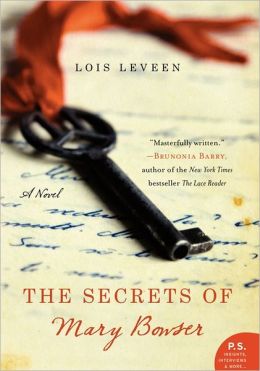
This summer I am enrolled in a course for American History teachers focusing on the use of primary documents in the classroom. As part of our course reading, we were required to read the historical fiction book entitled The Secrets of Mary Bowser. While this book is fiction, it is based on the life of an African-American woman who worked as a spy for the Union. It was a truly fascinated read and it taught me a lot about the Civil War and the years leading up to the conflict.
The book starts off with Mary as a child. She and her mother are owned my the Van Lews, a merchant family in Richmond that originally hailed from the North. Because Mary's mother, Minerva, used to be a slave in the North she was literate and passed this on to Mary. When the Van Lew's Northern-educated daughter, Bet, comes back from Philadelphia spouting grand ideas of abolitionism, she is pretty much ignored until the day she acquires the resources to buy her mother's slaves and offer them freedom. Unfortunately, freedom does not mean much for Mary's mother. Minerva is married to Lewis, a blacksmith enslaved to another Richmond gentlemen. Since freed slaves are not allowed to stay in the state of Virginia at the time, Minerva must make a choice about whether to stay with her husband or go North with her daughter. She chooses to stay. Bet pays for Mary to attend school in Philadelphia were she meets free blacks of all classes and becomes involved in the Female Anti-slavery Society there.
As Mary grows up she realizes that she wants to be more intricately involved in abolition, especially as the country moves closer to war. She also wants to be near her family. She moves South, marries, and work to support the North and the causes of freedom. Through a series of opportune circumstances Mary becomes a "slave" in Jefferson Davis's household. Really, Mary is a spy. She plays into the Davis's stereotypes of a dumb, illiterate slave, all the while ferreting messages out to help the North win the war.
Below I've included a few thoughts in response to some of the discussion questions we were asked to answer for class:
1.
Pick an
episode or a detail that you found surprising in the book. Why did this
particular facet strike you as unusual?
When Mary is freed by Bet Van Lew she is
sent to Philadelphia, the City of Brotherly Love to attend school. Philadelphia
was originally settled by Quakers and in the mid-1800s it remained a major
haven for that sect of Christianity. I had always believed that Quakers were
rare among Americans for their tolerance and charity toward others races.
However, I learned that not all Quakers subscribe to full equality for the African-Americans who attend their churches.
When Mary visits the Arch Street Meetinghouse she is directed to a bench in the
back reserved for the black attendees. Later, when Mary questions here Quaker
friend Zinnie about this practice, Zinnie emphatically declares that not all Quaker meetinghouses are so
segregationist. Zinnie is a Hicksite Quaker. Their principles are more
consistent with the tolerance and charity that I have always believed
characterized the Quakers. What I learned from this episode however, is that no
group of people can be painted with such a broad brush. For the sake of time in
our classrooms we tend to speak of people groups in generalities, though there
is much variance among individuals within those groups. Similarly, most Northern blacks remained poor and
servile, but there were some, such as Theodore and Philippa, who came from
wealthy black families. Their haughtiness seemed to overcompensate for their
race’s inferior position in society. The snobbery and pettiness that
characterized those circles mirrored the attitudes of grand houses of the South.
2.
How does The Secrets of Mary Bowser complicate
your ideas about slavery, the abolitionist movement, and the Civil War.
One of the qualities that I loved about
this book was that it did not draw simple categories of good versus evil. There
is a lot of gray in this story. Bet Van Lew, the wealthy, white abolitionist
who freed Mary and her mother was well-intentioned, but misguided and vain in
some of her pursuits. Throughout the book I believe the reader warms up to her
as she remained loyal to the cause and to Mary, and became by the end, a true
friend. Another example of such murkiness came about when Stowe’s Uncle Tom’s Cabin was published. We
teach that the book sparked controversy in the South and was lauded as a great
work of abolitionism in the North. However, among African-Americans there is no
such consensus. Some railed against is for its stereotypical portrayal of slaves,
others for the fact that Stowe expected slaves to escape to Canada in order to keep them out of the
United States. Many blacks criticized Uncle Tom. Some blacks distained his submissive
ways and the fact that he chose to stay rather than to escape. This of course
engenders fierce opposition from Mary, who understood why her parents chose to
stay in the South rather than risk the perilous consequences of the Fugitive
Slave Act.
Before reading the book I did not realize
that Virginia law in the mid-19th century required free slaves to
leave the state within a year of their freedom. In order to stay with her
husband, Mary’s mother, Minerva, could not act upon her freedom, but had to
keep up the appearance of being Bet’s slave as long as her husband Lewis
remained enslaved to Mahon. Truly, the choice between slavery and freedom
during this era was complicated by all sorts of considerations about family
ties. Those families who were fortunate enough to remain together often had to
do so at the cost of their freedom.
How
has the book changed or reinforced your ideas about the role of women and
African-Americans in this chapter of American history?
Women play a pivotal role during wartime.
This is a fact that I emphasize in my classroom. It was during America’s major
wars that women made their greatest strides toward equal rights. They led
boycotts during the Revolution and became respected as “Republican mothers.”
During the Civil War they acted in many capacities in both the North and the
South. Mary’s role was most remarkable. Mary was installed as a slave/spy in the Davis household. She played into all of
the stereotypes of slaves as stupid and illiterate. She uses this stereotype to
her advantage and is never suspected (as least by the Davis family) of helping
the North win the war. Bet, on the other hand showed the influence that
prominent white women could have on both sides of the conflict. Bet herself
made it her mission to care for the federal prisoners. Many other women during
this time took up jobs in field hospitals where they cleaned and bandaged
wounds, administered medicines, and a host of other menial tasks that freed
doctors to do the surgeries and amputations. During the Civil War modern
nursing was born.
This book is a truly fascinating adventure into one of our nation's most infamous eras. I've taught AP U.S. history for six years and I still learned a lot about The Civil War from reading this book. I came away full of admiration for the courage and the personal sacrifice of those who fought for the dream of real freedom. Truly, the quest for equality does not end with the end of the the Civil War. We know that blacks would keep on fighting for at least another 100 years. But Mary Bowser and others during the Civil War helped the nation take that next step toward real democracy.

No comments:
Post a Comment