Thursday, August 1, 2013
Book Review: Coming of Age in Mississippi by Anne Moody
Anne Moody's Coming of Age in Mississippi was a hard book for me to wrap my mind around. Not because it wasn't a good read, but because I still cannot seem to get how, only 50 years ago, white society could have supported - vehemently supported - the de jure segregation and blatant racism that was rampant throughout the South. I certainly know the causes of racism in terms of the sociological and economic forces as play, but I just do not get it. There is nothing in me that says: "Yeah, I think he or she is misguided, but I can certainly see the rational reasoning for thinking African-Americans are inferior." Nope. Don't get it.
I get classism. I get elitism. I just don't understand arbitrary racism. I understand why people railed against Rachel Jeantel when she testified at Zimmerman's trial. I even kind of understand why George Zimmerman might have racially profiled (if in fact that's what he did) a teenage African-American kid lurking about in the rain. There was crime in the neighborhood and statistics show more African-Americans are in gangs and found guilty of violent crime. While I would not have quickly jumped to the conclusion that Trayvon was up to no good, I can see why someone might have that reaction. There is some logical reasoning there and even some facts to back it up. But I don't understand the mentality that says African-Americans have to use the back door, or they can't sit in a restaurant, or we're going to kill them for registering to vote. It's completely irrational.
After reading Anne Moody's account of growing up in poverty in rural Mississippi, working for whites and eventually leaving her dysfunctional family to attend college and join the Civil Rights Movement, I was stunned not only at the complete irrationality of southern whites, but also by how far we've come in such a short time. I mean, my PARENTS were born during this era. They are old, but not THAT old. When I read about Anne getting ketchup dumped on her for sitting at a "White's Only" lunch counter and compare her struggles to the racial battles we're fighting today, I think we've come a long way. However, the media's agenda was not crafted with that sense of historical perspective in mind. While I was reading this book, I found it ridiculous to turn on the T.V. and see all kinds of African-American pundits arguing that America is still racist or that the legal system is still racist, etc. African-Americans voted in a black president (because they aren't subjected to ridiculous literacy tests or KKK violence) and they are allowed on juries. (Most likely the reason they were not on the Zimmerman jury is because they knew too much about the case beforehand, thanks to media hype) Of course, there are still some individuals who are racist, but society as a whole, including the media, the government, and the justice system is NOT rallying behind those skinhead quacks. They are the outliers now. White supremacists used to be the rule, you couldn't get into office in the South if you weren't racist. Now, any remark that could be even remotely racially charged constitutes political or economic suicide. (think: Paula Deen) Racist whites were ruling the media in the 1960s. Now CNN (based in Atlanta, a former hotbed of white supremacy) and many other major news outlets are actively supporting and rallying for racial, gender, and sexual equality. I'm not complaining. The end of racism and sexism is a very good thing, but I think as a society we need to celebrate these strides rather than make mountains out of molehills. I often feel that the media, aided by publicity-starved feminists and civil rights activists are trying to advance an agenda that that racism and sexism are widespread in this country. Now, I'll rant particularly against the feminists (because I'm a woman and I can do that.) I don't believe my society as a whole is sexist. I believe there are sexist people (i.e. Daniel Tosh ) and people have their sexist and demeaning moments (i.e. when they watch Tosh.0 or look at pornography), but overall, women aren't held back from doing what they want to do just because they are women. I believe that women make less than men because they get to a point where family becomes important and they CHOOSE to not accept certain promotions. I believe they do have natural God-given instincts toward mothering and that causes them to pursue a different path from many men. If you want to see REAL sexism read my post on the Bin Laden book - or just go to Saudia Arabia. If there is some racism and sexism still lurking about in society, I think it's of the more rational sort. We may link African-Americans with higher rates of crime (which is at least statistically proven) or guys may think of women as sex objects because they appear scantily clad on the covers of magazines. In short, racism and sexism are still subtly here, but they are present because some members of those communities won't change their negative behaviors. That's a whole different animal than the racism (and sexism) that was present in the early to mid 20th century.
So, if you want to see racism, I'll show you racism. Or rather I'll give you Coming Of Age in Mississippi. Yet, be prepared - it's an honest picture of whites and blacks. Anne Moody doesn't mince words in talking about members of her own community that are "Uncle Toms," or sell outs. Furthermore, she decries her own family and other poor, rural African-Americans who choose to bury their heads in the sand and accept the status quo rather than be a part of change. However, I can understand that. A lot of African-Americans never cared about registering to vote, never spoke up for their rights, and even decried those who did. Why? Because they had to feed their families. If speaking out meant you lost your position as a servant or field hand, then how are your kids going to eat? If registering to vote meant the KKK was going to come burn your house down and lynch you in front of your children, would you register to vote? You can understand then why the Civil Rights Movement depended so heavily on the contributions of young people. College students had less to lose. And yet, as Anne pointed out, many of them did risk their lives and put their families in danger. The KKK came after members of The Movement and their families. As Anne was actively campaigning to get African-Americans registered to vote, her mother and siblings were living in fear that the Klan would burn their house down and kill them.
Which leaves me wondering...would young people today be that brave? Perhaps they would if there was something compelling enough for them to fight for. But even the Zimmerman protests a few weeks ago died out rather quickly because, let's face it, it's not a huge problem - at least not compared to what it was in the 1950s and 1960s. History helps us put things into perspective. I just wish more journalists and pundits had a sense of historical perspective.
Wednesday, July 31, 2013
Book Review: A Dog's Purpose by W. Bruce Cameron
If you are a dog-lover looking for a light summer read while your pup snoozes beside you, then pick up W. Bruce Cameron's book A Dog's Purpose. If you don't believe in reincarnation, you'll have to suspend your disbelief, but really, it's not that long. I think you can do it.
This is a book written from a dog's eyes - or at least what we humans perceive a dog is thinking. The canine narrator takes us through several reincarnations as he seeks to find his purpose in the lives of his humans. During each life he learns new things about being a dog and eventually all of this will be important in reaching his "nirvana" - that place where he feels he's fulfilled his ultimate purpose as a dog.
What I enjoyed about this book is that it really takes you through many different dog experiences - stray dog, best friend, working dog, hero dog - the list goes on. This particular dog can remember his previous lives and do some comparisons, but this doesn't give him the kind of angst it would give us humans. Generally, he find himself pretty content once he's figured out what his humans want him to do and how he can make their lives better.
Ultimately, isn't that a dog's purpose? To make our lives a little better. They do that is so many ways. Some perform heroic tasks like finding bombs or lost children. Others provide a shoulder to cry on, a friend during those nasty adolescent years, and a friendly lick to come home to.
In short, if you're not a dog person, don't read this book. You won't get it. If you are a dog-lover, it's a nice little light read that will leave you feeling warm and fuzzy inside - and outside too if you take my advice and read it while snuggling your favorite canine!
Book Review: Growing Up Bin Laden by Najwa Bin Laden, Omar Bin Laden, and Jean Sasson
When Osama Bin Ladin was killed in May of 2011 he left behind four wives and dozens of children and grandchildren. We have not heard much about their story since, and to my knowledge, Growing Up Bin Ladin is the only inside account of the Bin Ladin family life before the attacks.
The book is a disturbing memoir of a wife and son who watch the man they love descend deeper and deeper into radicalism. The chapters alternate between those authored by Najwa, Bin Ladin's first wife, and her and Osama's fourth son Omar. The book opens with Najwa, young, innocent, and marrying her deeply religious cousin. He is from the well-to-do Bin Ladin family and offers her a life of comfort and safety in Saudi Arabia. Najwa leaves her home in Syria to join the Bin Ladin clan in Saudi Arabia, were she dons the hijab and remains virtually secluded within the confines of the family home. But all of these things are perfectly acceptable for a Middle Eastern woman from a traditional Muslim family. Her husband, not yet a religious extremist, treats her well, provides for her, though urges her to live simply, and rejoices with her at the birth of their sons.
This is the life that Najwa, and many other Muslim women, yearned for. For a few brief years it was the life she had. But her husband, always the devout Muslim, began taking his religion more and more seriously. He spent longer time periods away from home, fighting the Soviets in Afghanistan. Eventually that war ended, but the fuel for Jihad had been ignited in Osama's heart. He asked her if he could take another wife to produce more sons for Islam . These sons would be raised in the service of Allah. Many would later serve their father's nefarious purposes. Osama eventually took four wives, the maximum number dictated by Muhammad the Prophet. He spent equal time with each of them, alternating the nights that he stayed in each wife's quarters. The wives became friends. Truly, they had to. They had no one else. As Osama's activities became more radical he was exiled from Saudi Arabia, and they moved to Sudan where the women and children lived in seclusion, with only occasional trips to the family farm outside Khartoum.
Omar, a young child when his family left Saudi Arabia, mourns the loss of the horses on his families horse farm in that country. Growing up, Omar became an avid animal lover. He loved dogs, a species deemed unclean by Islam. He was an avid horseman like his father. He seemed to understand animals better than he understood the people in his world. Better, certainly, than he could understand his father who grew increasingly distant and radical during their days in Khartoum. Osama once trekked his entire family, wives and sons included, into the desert to sleep with no provisions, in order to train them to survive in harsh circumstances. The day would come, his father claimed, when the comforts of their home will be no more.
These words were darkly prophetic. Osama's actions became more radical, his rhetoric more virulent, and his was kicked out of Sudan, taking his son Omar with him to Afghanistan. The Taliban offers him refuge and a home in the city, and a mountain in Tora Bora. At this point Osama's radicalism had brought him to shun modern conveniences, so he moved his family, and his growing troop of followers all to the primitive outpost at Tora Bora. Omar is forced into his father's militant movement. Najwa continues bearing children, uncomplaining, yet unhappy. Omar begins questioning his father actions, he begins to consider escape.
Omar and Najwa were not living in the house in Abbottabad, Pakistan on the night that the rest of the family was killed/captured. In fact, this book was written a few years before the raid. They had left the clutches of religious fundamentalism. They were the lucky ones.
Osama Bin Laden has been the villian of our nation's story since September 11th, 2001. Yet, he was not the villian of this story - at least, not for Najwa. Perhaps he became a villain for Omar, yet deep at the heart of Omar's story is a boy just longing for his father's love and approval. Najwa's story is far more stoic. She is a woman telling the facts. She and Osama never divorced, she was still his wife, living in Syria on the day he died in Pakistan. She knew little of his political activity and judged him solely on how he treated his wives and children. He was, in her world, a very good Muslim. He took his devout nature to extremes later in their marriage, and yes, it resulted in much inconvenience for the family, but she remained with him, uncomplaining. She had to be essentially prodded away by her son, who warned her that something big was going to happen -something that would endanger her and her children's lives. I cannot understand this woman. How can you watch docilely as your husband takes another wife, and then another, and then another? How can you become friends with those wives?
Omar was a character that was easier to get. He was the one that rebelled against his father's extremism. Teenage rebellion is not something difficult for us to comprehend, and it's even easier when you're rebelling against the world's #1 terrorist. But through Omar's eyes we saw a man who was not a terrorist. He was a father. Not a very good father, but a father nonetheless. He did not love America, nor did he wish to throw away his religion. He just wanted a normal, Muslim life.
After finishing this book I went back and read the news reports from that fateful day two years ago. However, I read them with a different perspective. In those reports I read the stories of the women and children sequestered in that house, and indeed, in that mentality. They, like so many others in the fundamentalist community, are imprisoned in a world without education, without access to the outside, and with few avenues to change their situation. Nawja did not know what her husband was doing. She trusted that it was in the name of Allah and it was for the good of the Muslim world. But why can't Najwa and other women make that decision on their own?
Sadly, extremist Islam is growing. Though Osama Bin Laden's death caused a major setback for the Al Qaeda organization, extremist enclaves are expanding throughout Africa. We need to fight this battle, but let's do it with less drones and more books. Who's giving these kids education? Who's providing the resources? Who's getting them? Just boys? Or are girls allowed to go to school too? Are girls allowed to choose their path? If they are educated and given the chance to choose, my bets are that they are not going to choose a life of baby-making for jihad.
Monday, July 8, 2013
King Leopold's Ghost by Adam Hochschild
I just finished a rather harrowing journey back in time to the Belgian Congo via Adam Hochschild's book King Leopold's Ghost. In this non-fiction work Hochschild pummels the reader with a barrage of information from government records, personal accounts, and news articles that leave your head spinning and your mind envisioning severed hands, starvation and disease, and whips made of hippopotamus hide juxtaposed next to overwhelming opulence. King Leopold, the Belgian king who, along with his young country, was late into the Scramble for Africa, ended up with the interior - or the Congo River basin. But he made the best of it. Proclaiming himself to be a grand humanitarian, ridding Africa of those evil Arab slave traders, he put the native to work, first in bringing ivory and then in wild rubber harvesting. Of course, Leopold never went there directly. He obsessed about the Congo from home and had officials go there to explore and set up camp and force the "lazy natives" to bring in their quotas. In the meantime, the profits from their labor went into building and expanding Leopold's grandiose residences and lavishly providing for his very young mistress.
Leopold was quite the con-man, a talented manipulator. When negative press exposed his violent control of the Congo, he was able to weasel and bribe his way out. Though this is first and foremost a work of historical non-fiction, Hochschild's vivid characterization of King Leopold gives it a bit of the flair of a novel. You also meet several other notable figures. For example the explorer H.M. Stanley, African-American missionary William Sheppard, and the reformers who seek to expose Leopold: Roger Casement and journalist E.D. Morel. The author holds these latter two in high esteem as the first human rights reformers of the 20th century. They laid the groundwork for Amnesty International and a host of other organizations that seek to expose and correct human rights abuses.
I'm very glad I read the Afterword, because the author makes some excellent points by providing some insightful historical perspective. First, the Congo was by no means unique. Hochschild references the German genocide of the Harero people in Namibia, and the Portuguese abuses of forced laborers harvest cocoa beans (whose chocolate was purchased by Congo reformer and Quaker, William Cadbury.) However, the story of colonialism in the Congo provides enough fodder for a 306 page book, so he doesn't go into great detail about the other European colonies. Secondly, I like his point that Africa's problems today should not be fully blamed on European colonialism. Yes, that did have a share, and a very significant one. However, as Hochschild points out, other countries like South Korea and Ireland have come out from under colonialism to "build reasonably just, prosperous, and democratic societies." (pg 318) So what's the difference? What makes Africa so ill-suited to this end? Well, first, according to Hochschild, Africa's long history of chauvinism. Subjugating women generally has negative effects on society as a whole. By keeping women down, he argues, governments keep themselves down. I couldn't agree more. True, some societies are prosperous and chauvinistic (i.e. Saudia Arabia) but they are unique examples, often attaining their wealth by cornering a certain market (a.k.a OIL) and in the end, they are not really very nice societies to live in (unless you're really into high-end shopping, and not so much into human rights). Another reason for Africa's developmental crisis is the legacy of slavery. It's not just European slavery we're talking about here. Africans enslaved each other well before we started enslaving them. While the West was swept with abolitionism in the 19th century, Africa never had an abolitionist movement. Now that sounds a little paradoxical. Why would AFRICA need an abolition movement? I would argue that they do. The abolitionists fought for human rights, for the value of human life. It said that ALL people, regardless of race, class or national origin should be treated equal. Most of us Westerners have bought in to this ideal (although I'd argue we're secretly all a little racist in our own way - but that's a discussion for another time). Africans, for the most part have never had a movement that says "Hey! People have inherent value and rights and you should stop treating them like CRAP!" So, there you have it - child soldiers, blood diamonds, gang-rapes, tribal violence - all legacies of a mentality that says some people are just inferior. True, Europeans certainly made it worse, but I am going to go out on a politically incorrect limb nonetheless and suggest that Africa needs to take some responsibility for its troubles.
Wednesday, June 26, 2013
Book Thoughts: Snow Flower and the Secret Fan by Lisa See
Here's a book that will make every woman thankful she was not born in 19th century China! Snow Flower and the Secret Fan chronicles the life of two Chinese girls who are paired as laotong - a form of friendship that is meant to be closer than a husband-wife relationship. In a society where women are valued merely for their ability to produce sons, this kind of relationship is important.
In this book Lisa See grants us a peek into what it must have been like for women living in the isolated "inner sphere" of the home. For Chinese women the female world is both a source of great comfort and great strife. The main character, Lily, finds comfort in her laotong, a wealthy girl named Snow Flower. Yet throughout her life Lily is forced to live up to women's expectations. First, she must satisfy her mother who wants her to marry up, thus securing her future. Second, she must please her mother-in-law, the very proper Lady Lu. Most importantly however, Lily must live up to her husband's expectation that she will produce sons. If a Chinese woman cannot bear sons she is relegated to a low status among the women of her household. She is often treated cruelly by her mother-in-law, looked down upon by other women in the household, and forced to accept her husband's concubines.
In a society where women are beat down and forced to submit not only to the men, but just as often to other women, they find one method of release for their thoughts an emotions - the written code of nu shu. Nu shu is considered "women's writing" because it is in a slightly more feminine script than man's writing. Nu shu uses less characters and depends heavily on context. For many Chinese women this type of writing was a valued skill and an art form that the most prestigious young wives worked to master. As Lily becomes more adept in this script she finds freedom. Unfortunately, along with the freedom of literacy, comes the greatest mistake of her life, a mistake that leads to the undoing of her closest friendship.
While I have a decent amount of textbook knowledge on the subject, See's novel helped me to really understand two realities of life for Chinese women. First, women had no choice whatsoever. Their friends and their husbands were chosen for them. Lily and Snow Flower were matched by a local matchmaker. Their pairing was, in the eyes of Lily's mother, a tactical move to advance Lily into a good marriage. Later, Lily was paired in marriage with a wealthy man from a nearby town. Like so many women before her she was forced to marry a stranger and live with his family. Second, women were bound by duty. In the filial constructs of Chinese society, performing tasks out of duty is more important than love. It is a mother's duty to bear sons. If she is unfortunate enough to have daughters it is her duty to prepare them for marriage by binding (i.e. mutilating) their feet. Likewise, a woman is forced to serve her husband and his family out of duty.
As a 21st century female, I found this society extremely hard to comprehend. While I know about filial piety and the low status of women in Chinese culture, it was a rather disturbing glimpse into what it felt like to be a woman. The early part of the book describes the torturous practice of footbinding. Footbinding does not, as many people believe, result simply in a miniature foot. Footbinding is a process by which four toes are bent to meet the heel, leaving the big toe to walk on. Footbinding leaves women with a 3 inch foot, making them severely limited in their movement. Many girls die in the process. The bones break, the feet bleed and are subject to infection and gangrene. And yet, when the painful two-year process is over and they are leave with this 3 inch triangle of deformed flesh it is somehow considered attractive. I have a hard time with that.
This book also addresses what it is to love in this society. Though Lily and Snow Flower were matched to become laotong their love for one another was unconditional. Even during the turbulent periods of their relationship, Lily realizes how much she genuinely cares for Snow Flower. However, the other relationships were purely conditional. Lily loved her mother until she found out that her mother had been scheming behind her back. After Lily comes home from a grueling experience fleeing the Taiping rebellion we see a form of love between her and her husband. Yet, this love is based upon the fact that she is a proper woman who has born sons. I'm still left wondering - did husband-wife relations ever go any deeper? How sad it must be to live in a society where inability to bear sons meant a woman was of low character, where her value was tied to how she conformed to the standards and the amount of love she received was totally dependent on forces outside her control.
Perhaps trying to earn love is part of the natural human condition. I would venture to guess that in most of our relationships there is a level of filial piety. At work, school, church, even among friends we often have to perform a certain way and complete certain tasks to win approval and even affection from others. Yet hopefully most of us have more than one "Snow Flower" in our lives. Hopefully when we come home or talk to our best friends we find a place where duty is eclipsed by love.
Wednesday, June 19, 2013
Book Thoughts: Notes from My Travels by Angelina Jolie
I recently finished Angelina Jolie's journal from her travels to developing nations in 2001-2002. It was pretty much what you would expect. Basically you take a rich and famous movie star, plop her into a third world country, and tell her to write about what she sees. That's pretty much it. While it wasn't a total waste of time, there was nothing overwhelmingly spectacular about the book. It was not particularly well written, but I won't judge Jolie too harshly for that (after all she does warn us at the beginning that she is not a writer and was quite hesitant to publish her journals.) I was more astonished and appalled by Jolie's lack of research in preparation for her visits. For instance, when she arrived in Pakistan the UN contingent had to immediately find her some acceptable clothing. I mean really, Angelina, I'm sure UN workers have better things to be doing than taking you shopping for a burqa.
Another thing that bothers me about the book is that Jolie seems to grossly oversimplify the problems in the developing world. Basically, it comes down to the fact that we (the U.S? American citizens?) are not doing enough to help. We need to give more money. It keeps coming back to money. Money will fix all the world's problems. There is no appeal to the complicated and deep-seeded problems wrought by decades of colonialism (i.e. lack of industry, soaring population growth, environmental degradation, corrupt and incompetent leaders, tribal rivalries, etc). Jolie's lack of background knowledge about the places she's visiting leads her to the most simplistic answers. Quite frankly, she just sounds stupid.
Where, Angelina, should that money come from? Should we borrow money from China to donate to Africa? Or should it come from citizens? Perhaps if we all stopped going to movies we could make a significant dent in world hunger. And how exactly are you helping by traipsing around in a UN baseball cap? I'd venture to guess that the cost of your trips to "raise awareness" probably could have put a village full of kids into school for at least a year.
So, reader, if you want a truly worthwhile book on this topic let me suggest a few from people who have actually LEARNED about the developing world, SACRIFICED a good deal of money and comfort and ACCOMPLISHED something tangible.
Probably my top recommendation would be Mountains Beyond Mountains by Tracy Kidder. This book chronicles the story of Dr. Paul Farmer, a renown doctor who chose to invest his money and life into building up Partners in Health (PIH), an NGO bringing medical care to the world's poorest countries. I read this book several years ago and it stuck with me. Dr. Farmer is an incredible man.
Second, try Three Cups of Tea. This is the story of mountain-climber-turned-humanitarian, Greg Mortenson. After getting lost while attempting to climb K2 Mortenson ended up in a small Pakistani mountain village. This experience changed his life. He went on to establish the Central Asia Institute (CAI) whose mission is to build schools in the tribal areas of Pakistan and Afghanistan. Over the years Mortenson has risked his life to bring education to Afghani and Pakistani the boys and girls in some of Asia's most dangerous regions. Again, a truly remarkable and courageous figure.
Meanwhile Jolie is back in LA, having an expensive preventative surgery, followed by another expensive reconstructive surgery. All the while thousands of children are dying because they didn't have money for a simple vaccination. Nice work, Angelina. Enjoy those new boobs.
Friday, June 14, 2013
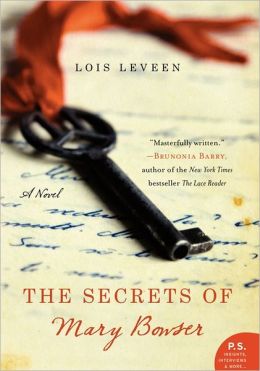
Book Thoughts: The Secrets of Mary Bowser by Lois Leveen
This summer I am enrolled in a course for American History teachers focusing on the use of primary documents in the classroom. As part of our course reading, we were required to read the historical fiction book entitled The Secrets of Mary Bowser. While this book is fiction, it is based on the life of an African-American woman who worked as a spy for the Union. It was a truly fascinated read and it taught me a lot about the Civil War and the years leading up to the conflict.
The book starts off with Mary as a child. She and her mother are owned my the Van Lews, a merchant family in Richmond that originally hailed from the North. Because Mary's mother, Minerva, used to be a slave in the North she was literate and passed this on to Mary. When the Van Lew's Northern-educated daughter, Bet, comes back from Philadelphia spouting grand ideas of abolitionism, she is pretty much ignored until the day she acquires the resources to buy her mother's slaves and offer them freedom. Unfortunately, freedom does not mean much for Mary's mother. Minerva is married to Lewis, a blacksmith enslaved to another Richmond gentlemen. Since freed slaves are not allowed to stay in the state of Virginia at the time, Minerva must make a choice about whether to stay with her husband or go North with her daughter. She chooses to stay. Bet pays for Mary to attend school in Philadelphia were she meets free blacks of all classes and becomes involved in the Female Anti-slavery Society there.
As Mary grows up she realizes that she wants to be more intricately involved in abolition, especially as the country moves closer to war. She also wants to be near her family. She moves South, marries, and work to support the North and the causes of freedom. Through a series of opportune circumstances Mary becomes a "slave" in Jefferson Davis's household. Really, Mary is a spy. She plays into the Davis's stereotypes of a dumb, illiterate slave, all the while ferreting messages out to help the North win the war.
Below I've included a few thoughts in response to some of the discussion questions we were asked to answer for class:
1.
Pick an
episode or a detail that you found surprising in the book. Why did this
particular facet strike you as unusual?
When Mary is freed by Bet Van Lew she is
sent to Philadelphia, the City of Brotherly Love to attend school. Philadelphia
was originally settled by Quakers and in the mid-1800s it remained a major
haven for that sect of Christianity. I had always believed that Quakers were
rare among Americans for their tolerance and charity toward others races.
However, I learned that not all Quakers subscribe to full equality for the African-Americans who attend their churches.
When Mary visits the Arch Street Meetinghouse she is directed to a bench in the
back reserved for the black attendees. Later, when Mary questions here Quaker
friend Zinnie about this practice, Zinnie emphatically declares that not all Quaker meetinghouses are so
segregationist. Zinnie is a Hicksite Quaker. Their principles are more
consistent with the tolerance and charity that I have always believed
characterized the Quakers. What I learned from this episode however, is that no
group of people can be painted with such a broad brush. For the sake of time in
our classrooms we tend to speak of people groups in generalities, though there
is much variance among individuals within those groups. Similarly, most Northern blacks remained poor and
servile, but there were some, such as Theodore and Philippa, who came from
wealthy black families. Their haughtiness seemed to overcompensate for their
race’s inferior position in society. The snobbery and pettiness that
characterized those circles mirrored the attitudes of grand houses of the South.
2.
How does The Secrets of Mary Bowser complicate
your ideas about slavery, the abolitionist movement, and the Civil War.
One of the qualities that I loved about
this book was that it did not draw simple categories of good versus evil. There
is a lot of gray in this story. Bet Van Lew, the wealthy, white abolitionist
who freed Mary and her mother was well-intentioned, but misguided and vain in
some of her pursuits. Throughout the book I believe the reader warms up to her
as she remained loyal to the cause and to Mary, and became by the end, a true
friend. Another example of such murkiness came about when Stowe’s Uncle Tom’s Cabin was published. We
teach that the book sparked controversy in the South and was lauded as a great
work of abolitionism in the North. However, among African-Americans there is no
such consensus. Some railed against is for its stereotypical portrayal of slaves,
others for the fact that Stowe expected slaves to escape to Canada in order to keep them out of the
United States. Many blacks criticized Uncle Tom. Some blacks distained his submissive
ways and the fact that he chose to stay rather than to escape. This of course
engenders fierce opposition from Mary, who understood why her parents chose to
stay in the South rather than risk the perilous consequences of the Fugitive
Slave Act.
Before reading the book I did not realize
that Virginia law in the mid-19th century required free slaves to
leave the state within a year of their freedom. In order to stay with her
husband, Mary’s mother, Minerva, could not act upon her freedom, but had to
keep up the appearance of being Bet’s slave as long as her husband Lewis
remained enslaved to Mahon. Truly, the choice between slavery and freedom
during this era was complicated by all sorts of considerations about family
ties. Those families who were fortunate enough to remain together often had to
do so at the cost of their freedom.
How
has the book changed or reinforced your ideas about the role of women and
African-Americans in this chapter of American history?
Women play a pivotal role during wartime.
This is a fact that I emphasize in my classroom. It was during America’s major
wars that women made their greatest strides toward equal rights. They led
boycotts during the Revolution and became respected as “Republican mothers.”
During the Civil War they acted in many capacities in both the North and the
South. Mary’s role was most remarkable. Mary was installed as a slave/spy in the Davis household. She played into all of
the stereotypes of slaves as stupid and illiterate. She uses this stereotype to
her advantage and is never suspected (as least by the Davis family) of helping
the North win the war. Bet, on the other hand showed the influence that
prominent white women could have on both sides of the conflict. Bet herself
made it her mission to care for the federal prisoners. Many other women during
this time took up jobs in field hospitals where they cleaned and bandaged
wounds, administered medicines, and a host of other menial tasks that freed
doctors to do the surgeries and amputations. During the Civil War modern
nursing was born.
This book is a truly fascinating adventure into one of our nation's most infamous eras. I've taught AP U.S. history for six years and I still learned a lot about The Civil War from reading this book. I came away full of admiration for the courage and the personal sacrifice of those who fought for the dream of real freedom. Truly, the quest for equality does not end with the end of the the Civil War. We know that blacks would keep on fighting for at least another 100 years. But Mary Bowser and others during the Civil War helped the nation take that next step toward real democracy.
Subscribe to:
Posts (Atom)