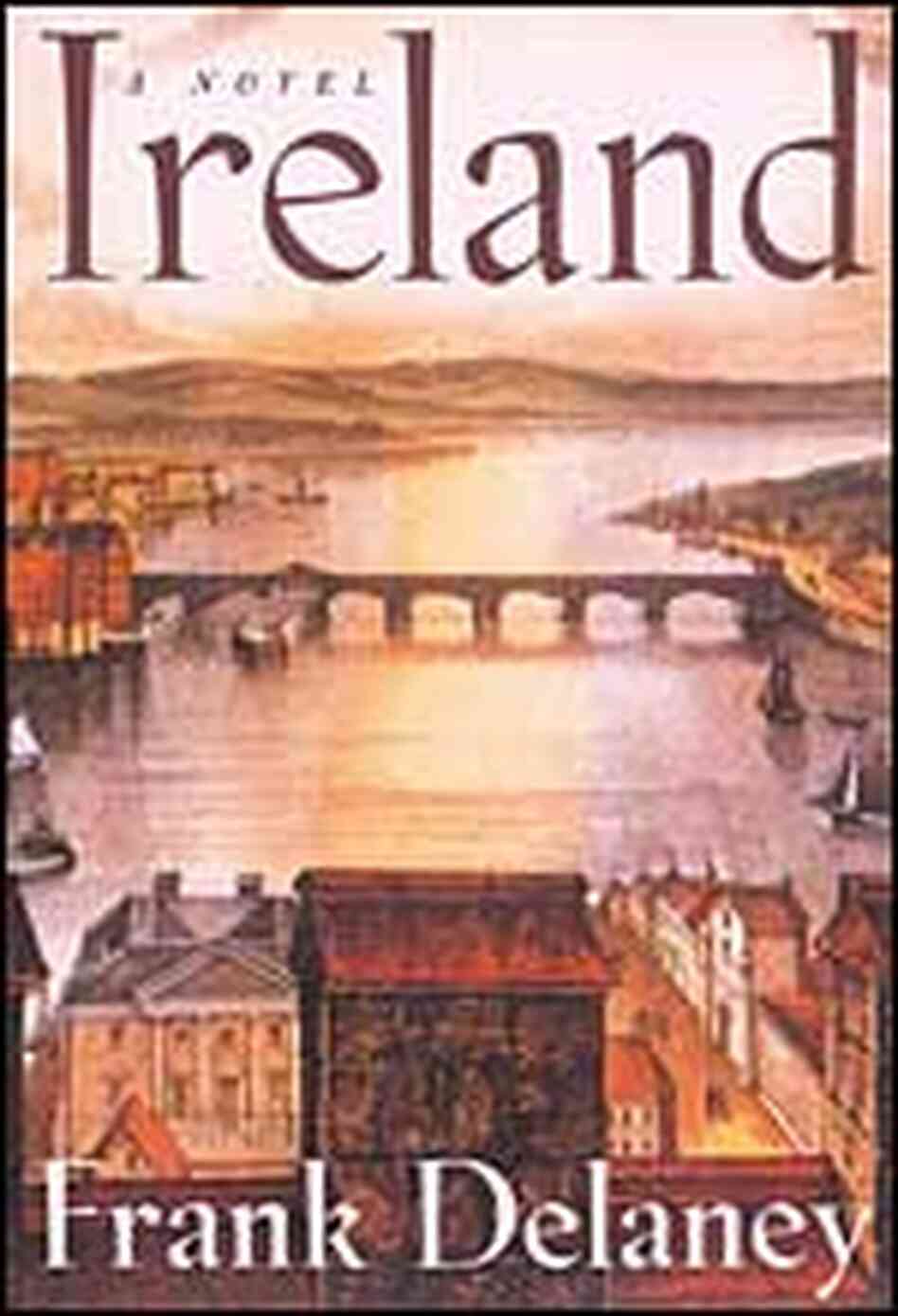
My husband and I plan on traveling to Ireland next summer, so I have begun my preparatory literary tour. This book was the first to come up in the library catalog when I typed "Ireland," and thus it become the first of several books about Ireland that I plan to read before leaving on our trip.
Frank Delaney's Ireland fuses history with legend, present with past, and old age with the inquisitiveness of youth. It is a book about heritage - the heritage of an entire people and a single family. It is the story of a young boy named Ronan whose life is radically altered by one of the last itinerant storytellers to traverse the hills and valleys of Ireland. The story begins in the 1950s when an elderly storyteller happens upon Ronan's house and asks for lodging in exchange for stories. The storyteller stays with Ronan's family for several nights and captivates the town with his telling of Irish folklore. When the storyteller abruptly leaves, giving no address and no other contact information, Ronan is devastated. Yet the storyteller knows that this young boy, so enraptured by the tales of Ireland, will grow up to be a storyteller in his own right. Throughout Ronan's teenage and young adult years he seeks to find the storyteller. Though the storyteller leave clues for Ronan along the way, the old man's whereabouts remain cloaked in mystery. Yet throughout these years of searching, Ronan travels the Irish countryside and learns the history of his land. Sometimes he hears the storyteller's own tales, recounted secondhand by a farmer or tavern-keeper, sometimes he learns the history from other voices, like those of his scholarly professor. All the while Ronan is not only piecing together the history of his beloved country, but he is also gaining insights into his own rich and scandalous heritage. And yet, Ronan's quest for the storyteller is ever haunted by the fear that he will never reach him, that the old man will die before Ronan can learn the trade. Why, you might ask, does the storyteller remain so elusive? Well, to find that answer you'll just have to read the book!
Delaney alternates between Ronan's story and the tales of Ireland's history. The history told here is a mixture of folklore, personal stories, and memory. To me, this is the only way to tell Ireland's history. Ireland is such a rich and mythical place that legends and fairy tales must form an integral part of its past. For centuries before the Irish were literate, their history was passed down through storytellers who brought the past alive through their captivating and sometimes fantastical tales. Thus, we the readers, must throw textbook history aside and embark on this journey with imagination in tow. The storyteller provides us with some facts, some myth, and many riveting stories of the people whose ordinary lives have integrally shaped their homeland. He transports us back to the Neolithic era, when tribal peoples roamed the green island amidst fairies, spirits and other mythical creatures of old. He will take us through the age of Viking invasions and the coming of St. Patrick, then up to the Norman invasions and the Great Potato Famine. The Normans, who came to Ireland via Britain initiated the slow seizure of Irish political independence. However, the Irish spirit remained alive and free, fueled by the stories of their forefathers. Their gallant fight against Britain brings the Southern counties out from under her thumb in the early 20th century, leaving the Northern counties seething even to this day. By the end of the book we have met kings and queens, warriors and monks, landlords and peasants. Thus, it not a top down history or even a bottom-up history. It is a collection of stories - stories that encapsulate all the allure that Ireland has to offer.
This is not a textbook, and by no means should it be considered a full account of Ireland's history. Yet, legends and stories allow us to really understand the character of the Irish people. They are not all descendants of the early tribal natives, but rather a fiery mix of native Irish, redheaded Vikings, and Normans. They've fought famine, and they've fought Britain. Both were strong foes, capable of winning many battles, but never capable of eradicating the Irish spirit. Delaney's book, in many ways, is the history of the oppressed, for Ireland is a land always dominated by stronger civilizations. While most of history is written by the victors, the stories of the Irish themselves are stories written and told by the conquered, passed down through the years and now told to their children, who still see their land divided, their religions at odds, and the turbulent forces of division ever-looming.
For one who is used to reading rather dry history texts full of facts and dates, this was an exciting journey for both the intellectual and imaginative facets of my mind. I felt that Delaney's book a beautifully written, fascinating start to my literary tour!

No comments:
Post a Comment